Friday, September 9, 2011

Excerpts of Interview - PP Sarsanghchalak Mohan Ji Bhagwat : AAJ Tak

By Prabhu Chawla  New Delhi, November 5, 2009
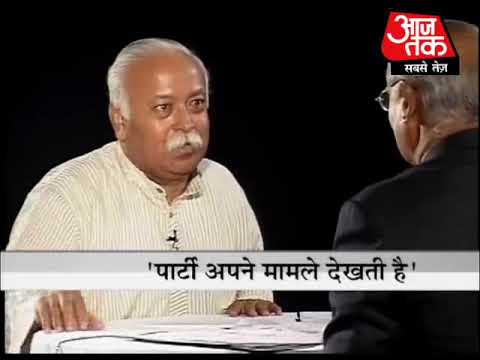
Sri Mohan Bhagwatji with Prabhu Chawla on Aaj Tak


At a time when the BJP is going through its worst existential crisis, the man with the walrus moustache and a mischievous glint in his eyes has become the most sought-after oracle in town. Mohanrao Bhagwat, the 59-year-old boss of the RSS, plays the role to perfection, and every word of his continues to be worthy of Page 1 nowadays. Watch interview
 
The media savvy Bhagwat's ascension as the head of the House of Saffron has marked a generational as well as cultural shift in the organisation. He is the moderniser, the 21st century face of the RSS. As the BJP seems to have abandoned its core ideology for the sake of coalition politics, Bhagwat has brought Hindutva back to the national agenda. As the BJP suffers from the absence of a leader who can take the party out of the wreckage of defeat, the sixth sarsanghchalak has become the supreme guide and the wise counsellor.
As the party retreats from the national mindspace, he styles himself as the last apostle of the nationalist cause. As its ambitious but discredited leaders struggle for the spoils of a lost war, he tells them: behave or be damned. Still, the Brahmin bachelor from Chandrapur in Maharashtra finds time to read the new Dan Brown.
Like the symbologist hero in The Lost Symbol, Bhagwat too has to think smart and act fast to save the Parivar he heads. In a candid conversation with Editor Prabhu Chawla for the Seedhi Baat show on Aaj Tak channel (today at 9.00 pm) at the RSS office in Jhandewalan in Delhi, Bhagwat talks about subjects ranging from the future leadership of the BJP to Vande Mataram, from Chidambaram to Modi, from Pakistan to China-and more. Excerpts.
Q. What do you think about the Deoband reaction againstVande Mataram?
A. Vande Mataram is for all Indians. It was part of our freedom movement and history. There was a time when both Hindus and Muslims sang it.
Q. The Muslims say it is against their religion.
A. I don't think any religion is against desh bhakti. To say Bharat Mata ki Jai and Vande Mataram is not like a religious puja or idol worship.
Q. What is the Sangh's view?
A. (Thumps the table) Vande Mataram kehna hoga (Everyone in India will have to say Vande Mataram).
Q. Do you think the minorities felt threatened after the Masjid fell?
A. I would say that the wishes of the Hindu samaj were ignored by the government. The anger against the system was taken out on the structure.
Q. But your strong take on the Babri Masjid, the Uniform Civil Code and Article 370 makes minorities insecure.
A. Just tell me why is there no rational dialogue regarding such matters. For 90 years there has been no court judgement (on the Ram Mandir). And when nothing happens, the average man loses his balance.
Q. V.P. Singh had a formula to build both mandir and masjid at Ayodhya. As a responsible organisation why don't you show some magnanimity?
A. This will not create unity. If a Ram Mandir is built peacefully, it will end Hindu-Muslim fighting. A mosque can't be constructed at the same site. Let them construct another mosque at some other place and the Hindus will extend all possible help.
Q. The Congress apologised for the anti-Sikh riots and Advani said the demolition was a national shame.
A. The Sangh did not say "demolish the structure" but the court's delay on the verdict angered the people.
Q. Do you agree with Advani that it was a national shame?
A. I don't agree with Advani on this issue. Why didn't they give legal permission for kar seva when so many people had collected for it?
Q. Why is the Sangh unwilling to do something which makes minorities feel safe? Whatever happened in Gujarat also added to the gap between the Sangh and the minorities.
A. Violence is wrong wherever it happens. Don't just look at one side. What happened in Godhra should not have happened. No one talks about the killings at Godhra.
Q. Should Narendra Modi apologise for the Gujarat carnage?
A. He is the head of a state, he has full knowledge of what happened and is capable of giving his reaction. If he thinks that something that needs an apology has taken place, then he will apologise. I am sure. I have also been told the speed with which the riots in Gujarat were controlled is commendable. Why should he apologise if he has done no wrong? That is not the way.
Q. Sonia Gandhi and Manmohan Singh were not responsible for the 1984 riots but have apologised. It increases their stature. If Modi or the RSS do the same, they will stand to gain.
A. At that time there was a comment, 'When a big tree falls, some things are bound to happen.' No such statement was made in Gujarat.
Q. Does it mean the RSS will never compromise on its core issues?
A. India's unity and integrity is nonnegotiable. So is the Ram Mandir at Ayodhya and a Uniform Civil Code.
Q. If I understand correctly, you still believe in Akhand Bharat and not in the two-nation theory.
A. It is all part of India. Pakistan is transitory and will become part of India sooner or later.
Q. What about Afghanistan?
A. Pakistan and Afghanistan are a part of us and will return one day.
Q. You claim that the RSS has no direct control over the BJP. But it sent 35 pracharaks to the BJP and they report to you.
A. It is not compulsory that they report to us. We only want them to stick to their principles. We don't interfere in their work.
Q. There have been reports of RSS pressure on the BJP, that Vasundhara Raje was removed because of pressure from the RSS.
A. The RSS had nothing to do with it. This is an internal matter of the BJP.
Q. Four months ago you talked about a change in the BJP leadership. The BJP lost three state elections and no change seems forthcoming.
A. Change will happen but at its own time. I only said what I have been told (by the BJP), they have a plan in mind and it is rolling on.
Q. There is a strong feeling that the RSS is intervening and imposing itself on the BJP.
A. The RSS never intervenes, only gives advice when asked.
Q. But you have said that the new leadership will be someone other than these four (Sushma Swaraj, Arun Jaitley, Venkaiah Naidu and Ananth Kumar).
A. Yes the new leadership will be someone other than these four. This is what I have been told. That is what has been agreed on and I believe the process has begun.
Q. You will get someone from outside Delhi between 50 and 55 years of age?
A. They will get someone from outside Delhi.
Q. In the last five-six years, several people who are media creations with no affiliation to the Sangh have come into prominence in the BJP. Has this lead to a dilution in ideology?
A. The Sangh is not against anyone, we don't look at anyone whether he is a swayamsevak or not.
Q. Are you worried about an image of corruption amongst the swayamsevaks who have joined the BJP?
A. Politics is a slippery ground but still we don't want to see one of our swayamsevaks slipping. We talk to them but it is up to the BJP to take action against them.
Q. The BJP is a visible face of the Sangh Parivar. Are you worried when you send workers to the party? They also get affected by the personality cult and the individual becomes more important than the organisation.
A. Yes we are worried and we do talk to them about it.
Q. Would you prefer that the party is led by someone who believes in the RSS ideology?
A. Who will lead the party is something they will decide. What we want is someone who articulates our ideology, believes in teamwork, encourages the younger generation and the difference in 'a party with a difference' should be visible to all.
Q. There are some outfits that are not part of the Sangh, yet there is a perception that they belong-like the Sri Ram Sene of Karnataka... Pragya Thakur. Why don't you disassociate the RSS from them?
A. I have already said that I have nothing to do with the Sri Ram Sene. There is no such thing as Hindu terrorism. No Hindu will support terrorism.
Q. Yet you supported Pragya Thakur.
A. No, all we said is that don't do a media trial. Let the courts decide.
Q. I saw a recent statement by the Sangh saying that P. Chidambaram is doing good work.
A. He is saying a lot of good things, but if he delivers on these, we will definitely praise him.
Q. Are we soft on China?
A. I have my doubts if the Government is alert on China. It has a well-defined strategy of encircling India. China has surrounded us by wooing our neighbouring countries from Maldives to Pakistan. We have to liberate our neighbours from the clutches of China.
Q. Have the Chinese defeated us at diplomacy?
A. Overtaken, not defeated. We can still do something.
Q. Regarding Pakistan, the BJP seems confused. What is the RSS view?
A. Pakistan exists on the premise of being anti-India. Pakistan needs to be given a decisive reply for all its mischievous actions, we need another military victory over Pakistan. That is perhaps the only way by which we can prevent a 26/11 and terror attacks.
Q. Have we lost an opportunity to score a military victory?
A. When Parliament was attacked and then after 26/11. Our government failed us then. We lacked the will.
Q. Do you agree that a strong and stable Pakistan is good for India?
A. If Pakistan is mentally healthy and gives up anti-India sentiments only then it's good for India.
For more Visit:
Copywrite IndiaToday 

Wednesday, September 7, 2011

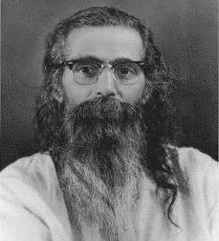
Remembering Param Poojya Golwalkar Guruji : 2nd RSS Sarsanghachalak


Param Poojya Golwalkar Guruji

Index


Introduction

After late Dr. Keshav Baliram Hedgewar, the founder and first Sarsanghachalak of Rashtriya Swayamsevak Sangh, pujya Golvalkar Guruji became the Sangh's second Sarsanghachalak and discharged this onerous responsibility till June 5, 1973, that is, for a full 33 years. These 33 years formed a very important period in the life of the Sangh as well as of the nation. It was full of many events – the 'Quit India' movement of 1942, the partition of Bharat in 1947 and the poitical independence of partitioned Bharat, the terrible bloodshed before and after the Partition, the massive influx of Hindu refugees into Bharat, Pakistan's invasion of Kashmir, Gandhiji's assassination on January 30, 1948, the vitriolic campaign unleashed against the Sangh in its wake, the blitz of violence against it and the ban on it, creation of the constitution of Bharat and determination of the form and policies of the Government of Bharat, formation of linguistic provinces, China's aggression on Bharat in 1962, Pt. Nehru's demise, the Bharat-Pak war of 1965, the second Bharat-Pak war of 1971 and the birth of Bangladesh, activities aimed at de-Hinduisation of Hindus, intellectual upheavel throughout the nation and so on. It was through this crucial period that pujya Guruji nurtured and developed the Sangh.

Travelling ceaselessly all over the country, he gave a powerful impetus to the organisation everywhere. Moving from place to place and garnering individual after individual he spread the network of Sangh all over the country.

Doctorji had stated the Sangh's ideology in a very brief outline. pujya Guruji elaborated its relevance most effectively. Extensive study, deep thinking, spiritual elevation coupled with the Guru's grace, selfless devotion to the Motherland, boundless love for the people, unparalleled ability to win over individuals and such other outstanding qualities enabled him not only to strengthen the organisation everywhere but also to provide mature intellectual guidance to the country in every field. His basic and constructive thinking on Bharatiya nationhood, the nation's destiny, and the right direction for its rejuvenation in modern times has now become the country's great intellectual heritage.

Pujya Guruji's life was thus unique and comparable to that of a sage. From the spiritual point of view he was a great Yogi, but as a devotee of God as manifest in the Society this great man lived in the midst of common people and cared for them like a mother. On the one hand, he loved solitude and had a detached mind, while on the other he was tremendously active in the life of the nation. All-in-all, his was a many splendoured personality.
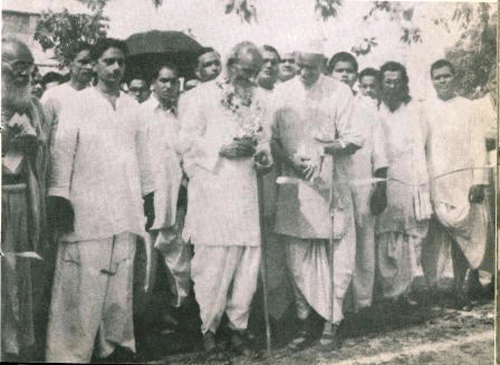
Pujya Guruji in Mathura on occasion of 'Gohatya Virodh' rally
Pujya Guruji had a clear vision of the ideal conditions in every sphere of national life. Guided by the firm faith that it was impossible for Bharat to become strong and confident enough to fulfil its destiny unless every aspect of the nation's life was informed with the pure and inspiring ideology of the Sangh, he pioneered the formation of many fields of such activity. It was pujya Guruji's tremendous drive and initiative that lay behind various nation-wide organisations like the Vishwa Hindu Parishad, Vivekananda Rock Memorial, Akhila Bharatiya Vidyarthi Parishad, Bharatiya Mazdoor Sangh, Vanavasi Kalyan Ashram and the Shishu Mandir educational institutions. Even in the political field, he presented Dr. Mukherji with a priceless jewel like Pt. Deen Dayal Upadhyaya.

In the event of temporary calamities, he guided various committees from time to time and motivated them to engage in relief work. He never allowed personal desires even so much as touch him. Consequently, pujya Guruji's intellectual guidance has left a comprehensive and indelible stamp on the nation's life. Thousands of people who received from him the blessings of the ideology of nationalism and a befitting view of life are even now active all over the country.

Those who were formerly under the spell of anti-national and fallacious thinking are now discarding their illusion and coming over to the Sangh's way of thinking. Even the charges levelled against the Sangh at the level in the Government have been proved false and baseless. Along with this, the motivated propoganda indulged in by selfish politicians in order to discredit the Sangh is fast losing force. Rather, those indulging in this anti-propaganda themselves have lost credibility in the people's mind.
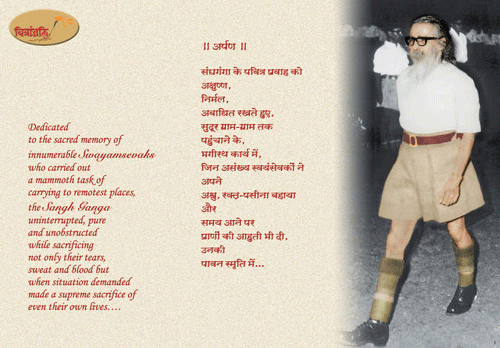
Pujya Guruji in the uniform of Rashtriya Swayamsevak Sangh
Without caring in the least about the opposition, pujya Guruji kept on fearlessly expounding the thought of our ancient cultural nationalism. His outstanding achievement was that he not only expounded the pure concept of nationalism but inspired thousands to live by it. Anti-propaganda often made pujya  Guruji a subject of controversy. Many of his statements were distorted by opponents for the sake of deriving political mileage. But pujya Guruji never got agitated, nor did he lose his equipoise. His mind could never be sullied by hatred. He never swerved from the goal of rejuvenation, in consonance with the Hindu view of life, of the Hindu Nation. He was extremely affectionate in his behaviour, but equally uncompromising in respect of principles. He never accepted any compromise that led to self-denial, self-deception or blemish on the nation's prestige.

No wonder, people want to know more about such an outstanding personality. It is nearly 25 years since pujya Guruji died of cancer, but Sangh Swayamsevaks still cherish many of his inspiring memories. In fact, the circumstances prevailing in the country today vividly bring back memories of the penetrating thoughts he had expressed, just like a prophet, from time to time. It is obvious that a nation's prestige stands on the quality of its people. Nor does a mere change of government create this quality. pujya  Guruji stressed the premise that there was no alternative to a system that ensured constant character-building. We experienced the truth of this view in the period of Emergency.
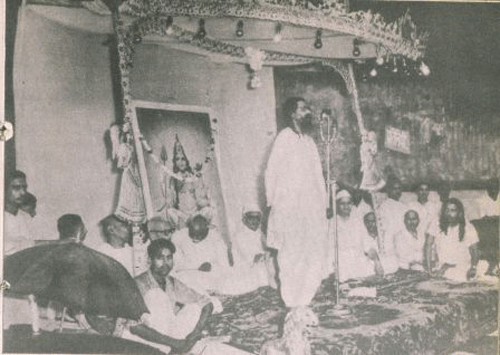
In Mathura for opening of 'Gogras yadnya' ( 9 August 1955)
The individual is the focal point of all types of actions, all kinds of transformation. If the individual is not good enough, he can set at naught even a good plan, a good system. The controversy that has arisen over the Constitution of Bharat today also justifies the all-out stress pujya Guruji had laid on human quality. As a successor of the two great dedicated predecessors Dr. Hedgewar and pujya Guruji, Sarsanghachalak Shri. Balasaheb Deoras also did remarkable work in the direction of making the Sangh co-equal with the whole society by giving new thrusts to its social service projects. The opponents of the Sangh tried to spread confusion by creating the illusion that there was a difference in the thinking of the three Sarsanghachalaks, but Balasaheb himself clearly dispelled all such disinformation tactics on many an occasion. He used to say, pujya Guruji had been selected by Doctorji himself and he, Balasaheb, had been selected by pujya  Guruji, and this fact was enough of an answer to those who spread the myth of difference between them.

Education and Sanskar

Some are born great, being born in rich and famous families. The families of the three previous Sarsanghachalaks of the Rashtriya Swayamsevak Sangh, however, had no such background of greatness or fame. pujya Guruji was born in a very ordinary family. His original surname was Padhye. The Padhyes belonged to a place called Golwali in Konkan in Maharashtra. Padhye means a practising priest. The family first migrated from Konkan to Paithan and later shifted to Nagpur. It was pujya  Guruji's grandfather Balkrishnapant who first came to Nagpur. This migration ended his connection with the priestly profession; so out of the surname Golwalkar Padhye only Golwalkar remained.

Pujya Guruji's father Sadashivrao lost his father at a very young age. So he was forced to give up education and take a job. For long years, he suffered the pangs of poverty. He got a job in the Post and Telegraph Department at Kamti near Nagpur. pujya Guruji's mother, Laxmibai, was from the Raikar family of Nagpur. Sadashivarao was known as Bhauji and Laxmibai as Tai. The couple had four sons, but the first two died as babies of just an year old. The third was named Amrit, but he too fell a prey to typhoid at the age of fifteen.

In The Mother's Lap

Pujya Guruji was the fourth offspring. He was born in the Raikar house in Nagpur at half past four in the morning on Phalgun Krishna Ekadashi (Vijaya Ekadashi) Vikram Samwat 1962, that is, February 19, 1906. He was named Madhav, but everybody in the family called him Madhu, a endearing name of his childhood. Out of a total of nine children of Tai-Bhauji only Madhu survived and naturally became the darling of his parents' love and hopes. When Madhu was just two years old, Sadashivrao left his job in the Post and Telegraph department and became a teacher. He got a teacher's job in a village of Chhatisgarh by name Saraipali. Saraipali is at a distance of 90 miles from Raipur and 60 miles from Raigarh. In those days, there were no means of transportation, so one had to either walk or travel on horseback. Madhu had to pass his childhood in an area that we now call as most backward and cut off from modernity. But when God wishes to fashion an excellent life He gifts that person with some extra benefit that can overcome adversity, provided of course, the individual is worthy of it. pujya Guruji possessed such worth since childhood in ample measures so he quickly assimilated the sanskars (the good cultural influences) inculcated in him by his parents.

While Bhauji was a sincere and self-respecting teacher of sterling character, Taiji was a very pious housewife and an ideal mother. Madhu's education began when he was just two years old. Whatever Bhauji taught, Madhu learnt it with ease. Taiji had not gone to school but she had a treasure house of stories capable of inculcating healthy sanskars. Madhu had an excellent memory and took advantage of that whole storehouse of knowledge. In his speech at Pune as Sarsanghachalak, reacalling what sanskars he had imbibed as a child first he said, "When I remember my childhood, my mind is filled with many sweet memories. All those events pass in succession before the mind's eye. I used to be woken up early in the mornings. My mother used to busy herself with household chores, but at the same time chant stotras and the names of God. Tai's melodious voice would fill my ears and heart. What a deep and noble impact those melodious tunes sung in the peaceful and elevating moments of the morning must have made on my young mind!"

In-Born Talent

Many incidents of Madhav's childhood days indicate that a razor-sharp-intellect, insatiable hunger for knowledge, extraordinary memory, willingness to alleviate the sufferings of others, extreme forbearance, absence of ego, purity of mind and such other exceptionally high qualities were developing in him right from those days. He was drawn to every good quality and had a deep-felt urge to acquire it. People came to know about these pujya Guruji's invaluable qualities specially when he became the Sarsanghachalak of the Rashtriya Swayamsevak Sangh. But his early life-story makes it clear that all these qualities had originated and developed even during his student days. For instance, serious reading, exceptional memory and the capacity to memorise and mastery over Hindi and English were among the qualities acquired during his early years. Right from the primary school stage he did extensive reading. He was a voracious reader and had read Shakespeare in full while still in the middle school. He also used to narrate to his fellow-students the stories of these plays in a most fascinating manner.

In the class, Madhav used to read some book while the teacher was teaching another one, but he was at the same time mindful of what was being taught. Once when the teacher saw some other book in Madhav's hands, he thought the boy was not paying attention to his studies. So in order to teach him a lesson, the teacher stopped a boy who was reading a lesson and asked Madhav to read from that point onward. Without a moment's hesitation, Madhav took up the text-book and began to read from the point where the first boy had left off. Both the students and the teacher were amazed. The teacher's ploy to teach Madhav a lesson had obviously failed.

Bhauji taught Madhav English right from his primary school stage. The boy made such rapid progress in the language that even when he was in the fourth standard he wrote letters in English to his maternal uncle in Nagpur. Father's job was in the Hindi territory, and because of his frequent transfers to places like Raipur, Durg, Khandwa and so on, Madhav became quite familiar with those territories and at home with Hindi. Marathi, of course, he knew well, as it was his mother-tongue. As a result of living in a variety of places, he came into contact with people speaking a variety of languages. His mind became broadened and the thought took root that all Bharatiya languages were his own.

As the Sarsanghachalak of Rashtriya Swayamsevak Sangh, pujya  Guruji had to make innumerable speeches all over the country. His oratory was powerful and inspiring. This quality too had developed in his school days. Even as a child, he had won prizes in elocution competitions. He lived a full life as a student – played a lot, studied a lot, helped his friends as much as he could, was modest and carried out happily all the household chores expected of him, and shared the joys and sorrows of others. The foundation of the future life of unique achievements was in fact laid in this period.

Later on, pujya Guruji's father had once said, "That Madhav could prove highly capable in later years, was clear from the qualities he displayed in his school days, but we had no idea that he would become so great. Now I do not grieve that among my children only Madhav survived, because in the form of Sangh Swayamsevaks we have thousands of children. "On such occasions, Bhauji's eyes would shine with pride over his unique son. At the same time, it must be borne in mind that the qualities of selflessness, dedication to duty, piety, hard work and pursuit of knowledge which were manifest in pujya Guruji's life became possible only because of the noble sanskars that his parents had inculcated in him. Shri Guruji too had, on many occasion, gratefully referred to their noble ideals.

There is an incident showing Bhauji's spirit of dedication and determination in pursuing a worthy goal. He was only a matriculate when he became a teacher. Many years had since passed. But he decided to graduate himself. It was twenty years after matriculation that he passed the Intermediate examination, and it took him another seven years to become a graduate! He discharged his responsibility as a teacher with due diligence, but in his spare time he also continued the mission of imparting knowledge. Mother Taiji was also of such a determined nature that in 1934 she performed a padayatra of nearly a thousand miles from Prayag to Alandi in the company of a saintly person named Sri Babaji Maharaj, and bathed the Samadhi of the saint Dnyaneshwar with the holy Gangajal brought from Triveni Sangam at Prayag in U.P. During this pilgrimage her back was scorched in an accident, but she bore the agony with equanimity and kept on walking.

Source: golwalkarguruji.org

Guruji's invaluable thoughts

Guruji’s thoughts on Economics :
  • Material wealth is to be acquired, so that we can serve God in the form of society, in the best possible manner, and out of all that wealth, only the minimum should be used for self-sake the denial of which will hamper out capacity for service. To claim or to make personal use of more than that is verily the act of theft against the society:
  • Vulgar, ostentatious and wasteful expenditure is a sin when millions are starving. There must be reasonable restrictions on all consumption. ‘Consumerism’ is not compatible with the spirit of the Hindu culture.
  • There need not be any rigidity about the patterns of industrial ownerships. There are various patterns, such as, private enterprise, nationalization, co-operation, municipalisation, democratization, self-employment, joint-industry etc. For each industry the pattern of ownership should be determined in the light of it’s peculiar characteristics and total requirement of the national economy.
  • But changes in the superstructure of society will be of no use if the mind of every citizen is not moulded properly. Indeed, the system works ill or well according to the men who work it out.
  • The Sanskaras of identification with the entire Nation constitutes the real social infra-structure of any socio-economic order.
Guruji’s one answer to all the challenges of Bharat

If once all the Hindus, whatever their political and other denominations, decide to stand shoulder to shoulder in a concerted manner as one national entity right form the Himalayas to Kanyakumari and form Dwaraka to Manipur, then all those others who have been living in this country will also learn to respect the Mother and the national entity here. Keeping their own faiths intact they will be able to become useful members of this great nation.

Guruji’s thoughts on True Dharma

Sri Rama, one of our greatest ideals, is a living example of this philosophy of victory. Killing of woman is supposed to be against kshatra dharma. It also ordains one to fight the enemy in the open. Nevertheless Sri Rama Killed the rakshasi Tataka and shot Vali from behind a tree. For, Sri Rama was aware of his ultimate duty of establishing the rule of righteousness by destroying the wicked. The slaying of an innocent woman is sinful but the same principle cannot be applied to a demoness. The technique of fighting also varies according to the nature of the enemy. This is the right understanding of kshatra dharma and Sri Rama followed it. There were in those times discriminating preceptors who preached the right concept; there were heroic disciples too who followed them.

The same has been the case with Sri Krishna and Arjuna. Just as the great war of Mahabharata was about to commence, Arjuna, seeing his elders and teachers like Bhishma, Drona, and others ranged against him, lost his spirits and threw down his bow. Seeing him confounded, Sri Krishna roused him saying, "Is not your name 'Vijaya' (Victory)? Your duty is to achieve victory on the battlefield. Why then do you delude yourself thus? Your foremost duty is to strike down evil and its supporters, whoever they may be, and establish the supremacy of the good and the just."

And again during the battle, when Karna had got down to lift up the wheels of his chariot stuck in the mud, Sri Krishna commanded Arjuna to direct his arrows at him. Karna appealed to Arjuna in the name of dharma, saying that it was adharma to strike at an unarmed and chariotless adversary. Then the great Yogi Sri Krishna thundered, "O Karna! What are the dharmic injunctions you have followed till today that you now come forward to preach dharma to us? Where had your dharma gone when all of you had surrounded the unarmed lad Abhimanyu and slaughtered him shamelessly? Where had your dharma disappeared when you insulted a helpless woman, Draupadi, in an open assembly? I know only one dharma to protect, and that is Dharmaraja!" It was because Sri Krishna presented this correct perspective and thereby steeled the will of Arjuna that the latter could fight the war and bring laurels of victory to the forces of dharma.

Golwalkar guruji’s message for Hindus to destroy Adharma and establish Dharmarajya  :

Let us, decide to tread that path, concentrating our attention and strength on reaching the final goal of victory over all the forces of evil. We are to test every act, apparently good or bad, on this touchstone of ultimate victory of the forces of dharma. That which leads to the victory of the virtuous and the righteous, is alone good and meritorious. And the examples and lessons of the victorious and the great will inspire us with the necessary will to win and awaken in us the right discrimination to achieve ultimate victory in the path of dharmasthapana, i.e., establishing righteousness all over the world, which has been our national life-mission since ages.

Guruji’s Wise Warning to Hindus

Pakistan's repeated aggressions upon us and its crimes against humanity and the way we have been reacting to them till now, hold a solid lesson for us. It would be futile-nay, it would be only inviting further and bigger troubles - if we merely take up a defensive posture and somehow try to save our skin; we should, on the contrary, vanquish such an evil enemy completely; not because we harbour any territorial ambitions but to put an end, once and for all, to his capacity to indulge in his anti-human crimes or to pose a threat to our security in future. Such a total victory ought to be our aim. Our wise forbears have declared agni-shesha, roga-shesha, runa-shesha and shatru-shesha (residues of fire, disease, debt and enemy) should not be allowed to persist. Even their smallest traces will have to be eliminated. Otherwise, the residual spark may well develop in course of time into an all-consuming fire. It is because many of our heroic commanders of freedom struggle in the past did not heed this wise warning that they had fallen a prey to wrong notions of Kshatra-dharma and let off the captured enemy kings and commanders. History tells us that these enemies recouped themselves, attacked our men once again and destroyed them.

Be world Missionaries

In a nutshell, our brethren abroad will have to bring about a total transformation in their thoughts and life-styles if they have to lead a happier, richer and more honoured life abroad and also make the image of Bharat shine brighter in those countries. And in order to do this the one supreme conviction that we are a great people charged with a World Mission, should ever be vibrant in our breasts; that a sacred duty and trust is cast upon us of bringing home to the entire humanity the sublime truths embedded in our Dharma and that the various ills and challenges being faced by it could be met successfully on the basis of the all-comprehensive, scientific yet spiritual outlook of Hinduism. If this ultimate vision is kept constantly is view then everything else will become clear as crystal.

Last message to Hindus : Reach the Goal at All Costs

Today, disintegrating forces are afoot in our country and the foreign powers are lying in wait to fish in the troubled waters. Some years back, the foreign powers had their hand behind the language conflict in Assam. Now it seems there is the foreign hand in the circulation of exaggerated news of persecution of Harijans. The foreign powers know very well that they can retain their supremacy in this country only by splitting the Hindus.

We must admit that we have not been successful, to the extent expected of us, in integrating the society and rousing the feeling of intense patriotism in it. As such, we have to be more keenly conscious of our responsibility, think about all aspects of our work, and put ourselves to the wheel wholeheartedly and with a resolve to reach the goal at all costs in the near future.

Important facts about Golwalkar Guruji

1. He gave the smallest message "Not me You".
2. He holds a record of number of trips all over Bharat.
3. He holds a record of writting maximum number of letters in his own handwriting.

Tuesday, September 6, 2011

Sarsanghachalak visits ‘Deekshabhumi’ of Nagpur

Sarsanghachalak visits ‘Deekshabhumi’ of Nagpur


buddha
In his first ever public appearance after becoming Sarsanghachalak, Shri. Mohanji Bhagwat visited Deekhsabhumi of Nagpur on the morning of 26 March. He was accompanied by many important Sangh functionaries of Nagpur on this occasion.
stoop
"The rebuilding of Bharat based on the ancient and eternal moral and spiritual values of this land was the dream of Dr. Babasaheb Ambedkar. I have come here to take inspiration from his work", he said.
ambedkar
Offering his Pranam to Dr. Babasaheb Ambedkar, he said, “Sometimes the contributions of great persons are not recognized immediately. But in due course of time everybody realizes it. It is time now that we recognize Dr. Babasaheb Ambedakar as one of the great saviors of Bharat”.
phulzele
The secretary of Dr. Ambedkar memorial committee Shri. Sadanand Phulzele welcomed Shri. Mohanji. Speaking on this occasion, he remembered the visit of previous Sarsanghachalak Shri. Sudarshanji and said that such visits create a healthy goodwill amongst various sections of society. Many prominent workers of the republican movement and neobuddhist movement were present at this function.
gallery
Shri. Mohanji also visited the gallery at the Deekshabhumi in his visit.

Interaction with SarsanghChalak Param Pujaneeya Sri Mohanji Bhagawat in Chennai

Interaction with SarsanghChalak Param Pujaneeya Sri Mohanji Bhagawat on 15-May-2010 in Chennai
 (Source - www.tamilhindu.com)


When you became the Sar Sangha Chalak you visited Dhiksha Bhumi…

It is only natural thing. Dr. Ambedkar had visited RSS camp and had appreciated the absence of even trace of caste feelings among Swayam Sevaks. When Dr. Ambedkar converted to Buddhism Guruji remembered what Swami Vivekananda said about the nation needing the intellectual acumen of Sankara and the compassionate heart of Buddha. And it was an RSS man Dattopant Thengadi (the founder of Sangh workers’ union BMS) who was the election agent of Baba Saheb Ambedkar.

But there are people who see Ambedkar as enemy of Hinduism…

See…Dr. Ambedkar knew the good intentions of Sangh Hindus. But he also knew that at that time Hindus at large had not had change of heart with respect to Dalits. He knew that though Sangh wanted and would eventually achieve a Hindu society free of casteism, Sangh at that time, had neither the strength nor the authority to bring that change at once. He thought Dalits should not endure injustice till such a change would eventually come. So he converted. But he converted to Buddhism which is rooted in the Indian soil and which he considered as an inalienable part of Hindu culture. He also wanted to make sure that the depressed sections of the society were not lured away by failed alien ideologies like Marxism. In fact Ambedkar told Dattopant Thengadiji that he stands as the bulwark between Dalits and Marxism just as Guruji stands as bulwark between Marxism and non-Dalits. (Of course we consider Guruji not as representing any sectarian section of Hindu society but his heart and vision encompassed entire Hindu society including Dalits and non-Dalits.)

India Today reported that you eulogize Gandhiji in your addresses.

Oh…That should not be a surprise. Surely I did not discover Gandhiji in Sangh. Guruji has a whole lecture praising Mahatma. And the name of Mahatma Gandhi has entered the morning prayer of RSS long before I even became Prantha Pracharak. Gandhian vision of village development, Swadeshi, cow protection etc is harmonious with Sangh
vision and mission. So if anyone is surprised because I mentioned Mahatma that surprise shows their ignorance of Sangh philosophy and history.

There are people who pit Ambedkar against Gandhi. How do you reconcile both?

All great leaders might have differences. But all of them valued society’s welfare and nation’s welfare. If we approach them in the same spirit, we can find harmonizing elements in them and learn from them in our own service to nation building. That has always been the approach of Sangh.

In Tamil Nadu there has been a strong movement to wean away Dalits from the national mainstream and Hindu culture. Does Sangh have any programme to counter this?

From the time of Meenakshipuram conversion, Sangh has paid special attention to Dalit problems in Tamil Nadu. There are many villages where untouchability has disappeared after Shakas appeared. In fact two villages which have been awarded Tamil Nadu government award for eradication of caste discrimination, are villages where Swayamsevaks have brought social harmony. In places where Dalits and non-Dalits have clashed Swayam Sevaks have been invited by both as peace makers. In Kerala also Sangh has worked dynamically for Dalit emancipation for example even at the famous Guruvayoor temple. Sangh has a clear vision that at every village access to water resources, living space, places of worship, hygienic conditions and cremation grounds should be common for all Hindus. In fact the numerical strength of Sangh activity and the disappearance of caste discrimination are directly proportional.

You have always stressed about Hindu-ness. Whom do you define as Hindus? Are religious minorities Hindus or non-Hindus?

All Indians who consider this land as their ancestral and sacred land are Hindus irrespective of their ways of worship. All Indians who follow the Dharmic values and Samskrti which this land has cherished are Hindus. Those who have alienated themselves as religious minorities should realize this truth for this is the truth about their own true self-identity. They are not the descendants of Babur or David but they are the descendants of Rama and Krishna and Bharatha. All those who fulfill these three conditions together are Hindus in Rastreeya sense.

What is Sangh view on environmental problems and sustainable development particularly in the light of threats like Global warming?

Our the Dharmic values and Samskrti as well as our way of life are always eco-friendly. We venerate nature. For us all nature is imbued with Divinity. Cow protection has been part of it. An enlightened environmental policy has to be scientific. For that we need models based on experiments. Sangh and Sangh-related organizations are conducting

such experiments throughout India. Also we should remember that a nation like Bharath has diverse eco-zones and we cannot have a single model and the regional environmental models have to be based on localized experiments. As I said there are many experiments like for example at Chitrakoot and in many villages in Maharashtra, Karnataka and Kerala. They will give us inputs to develop localized models for environmental policies which in turn will help us develop frame an enlightened and scientific policy for environmental problems and sustainable development.

With respect to science and spirituality India has an unique position among world civilizations. What is Sangh view with respect to science, Indian culture and world future?

For Hindus Science and Spirituality are not opposed. They are two sides of the same coin. Upanishad says that those who pursue only physical sciences (without the knowledge of inner sciences) fall into darkness. But those who pursue only inner sciences ignoring physical sciences fall into even greater darkness. For those who seek only liberation (Moksha) and not Artha (Economic welfare) and Kama (worldly pleasures) perhaps inner sciences alone may suffice. But for those who live in society, for them also Moksha is the goal but they also seek Artha and gratify Kama and in doing this the regulating principle is Dharma. This integral approach to life has made Hindu society approach science and technology in a holistic manner. In fact Dharmic values and Samskrti of Hindus never had problems with science (unlike the western society). However this is the theory. This is the principle that we have in our Sastras. The world will have to accept this approach to life. But that will happen and that can happen only when we produce large number of scientists who shall contribute to the improvement of welfare of humanity. World will listen only to those who have strength. So Hindus have to become strong if Mother Bharathi’s voice has to be respected and if Her vision has to be accepted by the world community. Working towards that is the duty of every one of us.

Friday, September 2, 2011

A book on RSS by a Muslim Minister

A book on the Rashtriya Swayamsevak Sangh(RSS) by a Muslim author? It may sound a bit far fetched but the book, in Kannada, is set to hit the stands in a week’s time. The work is authored by none other than the lone Muslim face in the B.S. Yeddyurappa government and minority welfare minister, Prof. Mumtaz Ali Khan.


Former Karnataka Minority Minister Sri Mumtaz Ali Khan

He told Deccan Chronicle that the book will try to demystify the misconceptions attached to the RSS and the myths propogated by the so-called secular parties. “It is exactly this misunderstanding between communities like Muslims and the RSS which inspired me to write the book,” he explained.
The book — Naa Kanda RSS (RSS which I have seen) — will focus on two diametrically opposite aspects of RSS functioning. “In the first part, the book will briefly discuss the core ideology of the RSS that was laid down by Madhavrao Sadashivrao Golwalkar, popularly known as Guruji in RSS circles, and another founding leader, Dr Keshav Baliram Hedgewar.

These two personalities have never in their life, discussed or criticised any religious group. All their energy was spent on organising the nation on the basis of the single nationhood concept. They never spoke or propagated any ill feeling towards any community. This needs to be told to all Muslims openly as they have been misguided due to the Congress party’s calculated campaign in the last 60 years,” he said.

In the second part, the author interprets how, in their attempt to to counter the Congress, a section of RSS leaders deviated from the core ideology to launch a campaign against minorities.

“The RSS is being branded as a communal organisation only because of the actions of a section of the lower RSS cadre, who try to blow every sensitive issue out of proportion. This happened due to the lack of proper education about the core ideology itself among lower cadre. Besides this, a large section of Muslims are not educated and do not know what the RSS is and what their teaching are. This has led to a deepening of the mistrust between the two biggest communities in the country. As an author, I am trying to bridge this gap by highlighting Dr Hedgewar and Guruji’s statements on sensitive issues like the Common Civil Code and conversions. Both of them had simply stated that their utmost concern was to unite the nation,” he said.

Source: DECCAN CHRONICLE
http://www.deccanchronicle.com/channels/nation/south/lone-muslim-minister-pens-book-rss-038

Thursday, September 1, 2011

Muslim groups back RSS leader Indresh

Several Muslim leaders and organisations have come out in support of senior RSS leader Indresh Kumar.

Claiming that Indresh had been championing the cause of Hindu-Muslim unity, president of Mirza Ghalib Society Shamshad Ali Shaad said, “A person like Indresh Kumar can never be involved in a terrorist attack on a Muslim shrine”.

Two other well-known Urdu poets, Abdul Gaffar and Mirza Habib, expressed similar views. They said Indresh Kumar was the “guiding spirit” in the formation of organisations like Rashtravadi Muslim Manch and My Hindustan, which are engaged in removing misconceptions about RSS within the Muslim community.

They said that the ATS sleuths were trying to implicate Indresh Kumar without having convincing proof against him. “The case against Indresh Kumar will fall flat during trial,” they commented.

Salawat Khan, chairman of the State Waqf Board said the efforts by the ATS to implicate Indresh Kumar would collapse in course of time.